
Bachata vs Salsa: What's the Difference?
Two of the world's most popular Latin dances, often played at the same events, but with very different music, rhythm, and movement. Here's how they compare.
The short answer
Bachata uses an 8-beat pattern (1-2-3-tap, 5-6-7-tap) with guitar-based music and emphasizes hip movement and close connection. Salsa uses a faster 8-beat pattern (1-2-3-pause-5-6-7-pause) with horn and percussion-based music and emphasizes footwork, turns, and partner patterns.
Quick Comparison
Before we dive deep, here's a side-by-side snapshot of how bachata and salsa differ:
| Bachata | Salsa | |
|---|---|---|
| Origin | Dominican Republic (1960s) | Cuba / New York (1960s–70s) |
| Timing | 1-2-3-tap, 5-6-7-tap (8 beats) | 1-2-3-pause-5-6-7-pause (8 beats) |
| Tempo | Slower (about 110–150 BPM) | Faster (usually 160–220 BPM) |
| Key Instrument | Guitar (requinto) | Horns, piano, congas |
| Movement | Hip movement, body waves | Footwork, turns, patterns |
| Connection | Close, chest-to-chest | More open, arm-leading |
| Difficulty | Easier for beginners | Steeper learning curve |
The Music
The biggest difference between bachata and salsa is the music itself. You'll hear it immediately:
Bachata Music
Bachata is guitar-driven. The requinto guitar carries the melody, accompanied by bongó drums, güira (metal scraper), and bass. The music tends to be romantic, emotional, and mid-tempo. Modern bachata (like Romeo Santos and Prince Royce) adds R&B and pop production. Learn more about the history of bachata music.
Salsa Music
Salsa is horn and percussion-driven. You'll hear trumpets, trombones, piano (montuno), congas, timbales, and cowbell. The music is faster, more energetic, and often features call-and-response vocals. Salsa draws from Cuban son, jazz, and Afro-Caribbean rhythms.
The Dance
Bachata Dancing
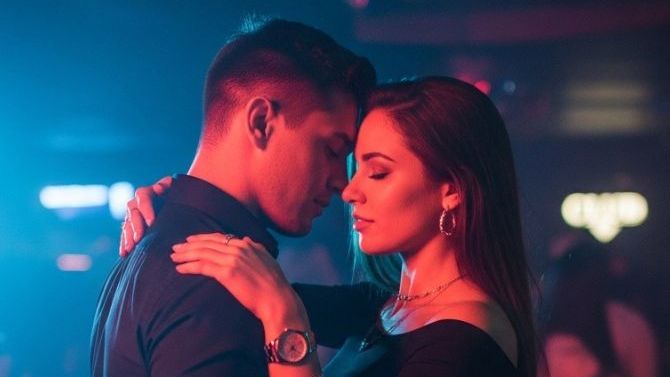
Bachata is danced in a side-to-side pattern, step, step, step, tap. The emphasis is on hip movement, close connection, and musicality. In bachata sensual, dancers add body waves and fluid movements. In típico, the footwork is faster and more syncopated. The dance is intimate, expressive, and romantic.
Salsa Dancing
Salsa is danced in a linear or circular pattern depending on the style (LA-style is linear, Cuban-style is circular). The emphasis is on fast footwork, turns, and partner patterns. Salsa is more athletic and visually dynamic, with leaders guiding followers through complex turn patterns and shines (solo footwork).
- Bachata timing: 1-2-3-tap, 5-6-7-tap (simple, intuitive)
- Salsa timing: 1-2-3-pause, 5-6-7-pause (requires more practice to internalize)
- Bachata frame: Close hold, often chest-to-chest
- Salsa frame: More open, connected through hands and arms
Origins & History
Bachata was born in the Dominican Republic and was first recorded in the early 1960s. It emerged from working-class neighborhoods and was stigmatized for decades as music of the poor. Artists like Juan Luis Guerra, Aventura, and Romeo Santos eventually brought it to the global stage. Read the full history of bachata.
Salsa developed in Cuba and New York City in the 1960s–70s. It's a fusion of Cuban son, mambo, jazz, and other Caribbean influences. The Fania All-Stars, Héctor Lavoe, Celia Cruz, and Willie Colón are among the genre's most iconic figures. Salsa quickly became the sound of Latin New York and spread worldwide.
Despite their different origins, bachata and salsa coexist beautifully. At most Latin dance socials, you'll hear both genres played, and many dancers know both styles.
Which Should You Learn?
The honest answer? Learn both. But if you can only start with one:
- Choose bachata if you want to get on the dance floor quickly. The basics are easier, the music is slower, and you can look smooth sooner. Check our complete beginner's guide to dancing bachata
- Choose salsa if you love high-energy dancing with lots of turns, footwork, and dynamic partner work. The learning curve is steeper but the payoff is enormous
- Choose both if you want to be the person who never sits down at a Latin dance event, and trust us, that's the goal!
For bachata music recommendations, check out our 25 best bachata songs of all time.
Frequently asked questions
What is the difference between bachata and salsa?
Bachata uses an 8-beat pattern (1-2-3-tap, 5-6-7-tap) with guitar-based music and emphasizes hip movement and close connection. Salsa uses a faster 8-beat pattern (1-2-3-pause-5-6-7-pause) with horn and percussion-based music and emphasizes footwork, turns, and partner patterns.
Is bachata or salsa easier to learn?
Bachata is generally considered easier for beginners. The basic step is simpler (side-to-side vs forward-and-back), the music is slower, and the timing is more intuitive. However, both dances have equal depth at advanced levels.
Can you dance bachata and salsa at the same event?
Yes! Most Latin dance events play both bachata and salsa music. DJs often play both genres over the course of the night. Many social dancers know both styles.
Should I learn bachata or salsa first?
If you want quick wins on the dance floor, start with bachata, the basics are easier. If you love fast, energetic dancing with lots of turns, start with salsa. Ideally, learn both, they complement each other.